
A white label online casino is a casino you launch under your own brand on a platform that another company builds, runs and, in many cases, licenses. You bring the brand and the players. The provider brings everything underneath: software, games, payments, compliance tools and often the licence itself.
What matters more is how the model is used. In 2026, white label is a way to enter a market, not a way to build a casino business for the long term. Used as a short bridge, it can save you months and a large part of your launch budget. Signed as if it were permanent, it becomes the most expensive decision in your business plan.
This guide explains how the model works, where it still makes sense, and what we would want settled before signing one.
- A white label is not a type of licence. It is an arrangement in which a licence holder lets your brand operate under its licence and on its platform.
- The licence is the part that decides everything: which markets you can serve, which partners will work with you, and what happens if the provider runs into trouble.
- The cost that matters is the revenue share, because it grows as your casino grows.
- The best white label contracts are judged on their exit terms. If you cannot take your players, domain and data with you, you are not building an asset.
What a white label casino is, and what it is not
Think of it as renting a fully fitted shop inside someone else's licensed shopping centre. The sign over the door is yours, and so are the window displays and the customers you bring in. The building, the electrics, the till system and the trading permit belong to the centre, and so do the rules.
Providers describe what they sell in three overlapping layers, and the words are used loosely:
- Software
- The casino engine: player accounts, wallet, bonus logic and back office.
- Platform
- The software plus content and payments already connected, so you have games to offer and a way to take deposits.
- Solution
- The platform plus the business wrapper: the licence, compliance tooling, merchant accounts and support.
A white label sits at the "solution" end. That is why it is fast, and it is also why the contract matters more than the brochure. Two packages both called "white label" can differ completely in what they include.
A white label is not a licence category. Major regulators do not issue a "white label licence". The model exists because some licence holders are allowed, under their own licence, to host several branded sites. Your casino operates in that space, which is why the licence shapes everything else in this guide.
Who does what
The work splits in a predictable way, although the exact boundaries are set by your contract.
| Area | Provider | You, the operator |
|---|---|---|
| Platform, hosting and updates | Runs it | Uses it |
| Games | Supplies the catalogue, usually via an aggregator | Chooses from what is available |
| Payments | Integrates methods and often holds the merchant accounts | Requests local methods for your market |
| KYC, AML and responsible gambling | Provides the tools and the policies | Follows the policies and works the alerts |
| Licence | Often holds it | Needs to know exactly what that means (see below) |
| Brand, design and promotions | Sets the limits | Owns them, within those limits |
| Player acquisition, retention and first-line support | Rarely | Yes |
Look at the last row. The provider takes away the technology problem, but the two jobs that decide whether a casino survives, winning players and keeping them, stay entirely with you. A white label shortens the road to launch day, but running the casino after launch is still your job.
How a white label launch actually works
Most launches follow the same five stages.
- Choose your markets and your licence route. Where you want to accept players decides which providers and licences are even options. This comes before any demo.
- Pass the provider's due diligence. Expect to submit a business plan, ownership documents and identification for every beneficial owner, and proof of funds. Providers vet you this carefully because, as the licence holder, they answer to the regulator for what you do. Some will only take operators with previous iGaming experience.
- Agree the commercial terms. These are the setup fee, any monthly fee, the revenue share, and the terms for leaving.
- Brand and configure. This covers your front end, game selection, payment methods for your market, bonus rules and support channels.
- Test and go live. You check registrations, deposits, withdrawals, KYC flows and bonuses end to end before real players arrive.
On a provider's licence, this usually takes three to eight weeks from signature. The platform is rarely the bottleneck. What slows launches down is licensing, if you need your own, and payments, because getting the right local methods approved for a new brand takes longer than switching on a theme.
The licence question: where white label still works
For years, the model ran on offshore licences, sometimes called international or ".com" licences. Under these, one licence holder could carry many brands. National regulators have moved the other way: they increasingly want to know exactly who is offering gambling to their residents, and to hold that party directly responsible. Two jurisdictions show where this leaves you.
The United Kingdom. UK white labels are not banned, contrary to claims by some platform providers that the UK does not permit them, but they are often misunderstood. The Gambling Commission's position is that the licensee is always the party offering the gambling. In its words, a white label relationship "is better described as a marketing agreement". Legally, you are the licensee's marketing partner, and any breach on your site is the licensee's liability.
That is why UK licensees now vet their partners so hard. The case that changed the market was TGP Europe. The Commission fined it £316,250 in 2023, partly for failing to carry out due diligence before signing white label agreements. In May 2025, TGP surrendered its licence after being told it faced a £3.3 million penalty. Its best-known partner, Stake.com, had already left Great Britain two months earlier, in March 2025. On someone else's licence, their compliance record is your business risk.
Curaçao. This was the traditional home of the white label, with brands running on sub-licences under a few master licences. That route has closed. The National Ordinance on Games of Chance (LOK) came into effect on 24 December 2024. The Curaçao Gaming Authority now issues licences directly, and each business needs its own. Our Curaçao regulation guide sets out the current requirements and fees.
Before you sign, get three answers in writing:
- Whose licence number will appear on your site?
- What is your legal role: licensee, sub-licensee or marketing partner?
- Which markets are you barred from serving, and who decides if that changes?
What you pay for, and why one cost matters most
A white label bill has three parts, and they behave very differently.
- The setup fee is paid once. It is the number everyone negotiates hardest, and in the long run it matters least.
- The monthly platform fee is fixed and predictable. Some providers do not charge one.
- The revenue share is a percentage of your gross gaming revenue (GGR), paid for as long as the contract runs. It is the cost that grows as you succeed, so you pay the most precisely when the business is doing best.
Published guides quote revenue shares anywhere from around 15% to 50% of GGR, and both ends can be accurate. They usually describe different bundles: one price covers only the platform, while another also covers games, payments and the licence. So do not compare headline percentages. Ask each provider for the all-in share once every component is included, and check whether it is charged on GGR or on net revenue after bonuses and taxes.
To see why the revenue share dominates, take a casino earning $200,000 a month in GGR, or $2.4 million a year. On a like-for-like, all-in basis, every 5 percentage points of share costs $120,000 a year. A provider charging 30% instead of 25% therefore costs you more in the first year than most setup fees.
When the numbers say it is time to move
Leaving a white label is an arithmetic test, not a feeling. Take your annual GGR and multiply it by the difference between your all-in white label share and a turnkey quote. Compare the result with the yearly cost of your own licence plus a turnkey platform. A Curaçao B2C licence, for example, costs about €47,450 a year plus a €4,592 application fee. When the first number is clearly larger, and your forecast says it will stay that way, start planning the move.
| White label | Turnkey | In-house build | |
|---|---|---|---|
| Who holds the licence | Usually the provider | You | You |
| Upfront cost (SOFTSWISS estimate) | About €20,000–60,000+ | About €60,000–100,000+, plus licensing | €100,000+, often far more |
| Time to market | Weeks | Weeks for the platform, plus your licence timeline | Many months to years |
| Ongoing platform cost | Highest revenue share | Lower share or fixed fees | No platform share, full team cost |
| Who keeps the players | Depends on the contract | You | You |
The risks, and what each one means for you
Your margin shrinks as you grow. A revenue share suits a small casino and punishes a big one. Once the share alone costs more than a turnkey platform plus your own licence would, the white label has done its job.
Your licence is someone else's. If the provider loses or surrenders its licence, or leaves a market, every brand on it goes too. You inherit their regulatory record without any say over it.
Partners judge you by your licence. Payment providers, game studios and affiliates often treat a brand on a shared licence differently from a directly licensed operator. Some will not work with white label brands at all, and that can narrow your payment options and your affiliate pool.
Your product looks like everyone else's. Brands on the same platform share the same core features, cashier and flows, and experienced players and affiliates notice. Your differentiation has to come from brand, offer and CRM, because the product cannot provide it.
Your growth channels may be capped. If you plan to win players through organic search, check how much control the front end gives you over page structure, metadata, speed and content. Template sites are often hard to optimise, and that only becomes obvious after launch.
Your money may sit in their accounts. Where the provider holds the merchant accounts, player deposits settle to the provider first. Payment providers can hold back a rolling reserve for months, and if the provider fails, player balances are not automatically yours to pay out.
Leaving can mean starting again. If the player database, domain or merchant accounts belong to the provider, moving to your own platform means rebuilding from zero.
Who a white label suits, and who should skip it
It fits:
- Affiliates and media brands that already have an audience and want to convert it themselves rather than earn commission on it.
- Operators testing a market before committing to a full licence application there.
- Crypto-first brands targeting markets where offshore licences are accepted.
- Brand-led businesses without a technical or compliance team that want to learn the operation before building one.
Skip it if:
- You want to be the legal operator in markets that require a local licence, such as most regulated European markets or Ontario.
- Your plan depends on product differentiation that a shared platform cannot provide.
- Your forecast shows rapid growth, because that is exactly when the revenue share becomes the largest line in your P&L.
The Gamitas view: treat it as a bridge, not a destination
Much of the current commentary on white label comes from providers that now sell turnkey platforms, and it tends to call the model obsolete. We would put it differently. White label has not disappeared, but its job has narrowed. It remains a legitimate way to get live quickly, test demand and learn the business. The mistake is signing a white label contract as if it were the business itself.
Our marketplace data adds a practical warning. Of the 49 white label and turnkey suppliers on Gamitas, 19 currently have a licence that Gamitas has verified against a regulator's register. Among the licences on record, Malta Gaming Authority licences are the most common (14 suppliers), followed by the UK Gambling Commission (8) and the Curaçao Gaming Authority (7). Brazil is the market most often listed as live (11). The point for a buyer is that a licence claimed in a sales deck is not the same as a licence you have checked. Ask for the register link before the demo, not after, and check it on the regulator's register yourself.
For an operator, that suggests a practical rule: choose a white label partner that can also take you to turnkey. Look for a provider that holds licences in the markets you want to reach next, offers a turnkey route on the same platform, and agrees in the contract that your players, domain and data move with you. That way, the white label leads to a business you own rather than a rebuild.
Questions to settle before you sign
Licence
- Whose licence is it, and what is your legal role under it?
- Which markets are included and which are excluded?
- What happens to your site if the provider's licence is suspended or surrendered?
Money
- What is the all-in revenue share, and is it charged on GGR or on net revenue?
- Are game studio fees inside the share or billed separately?
- Is there a minimum monthly fee or a revenue guarantee?
- Does the provider or the payment provider hold a security deposit or rolling reserve, and when is it released?
Exit
- Do you own the player database, and can you export it?
- Are the domain and brand registered in your name?
- Who holds player balances, and who pays them out if the contract ends?
- What is the notice period, and is there a turnkey migration path on the same platform?
Finding a white label provider
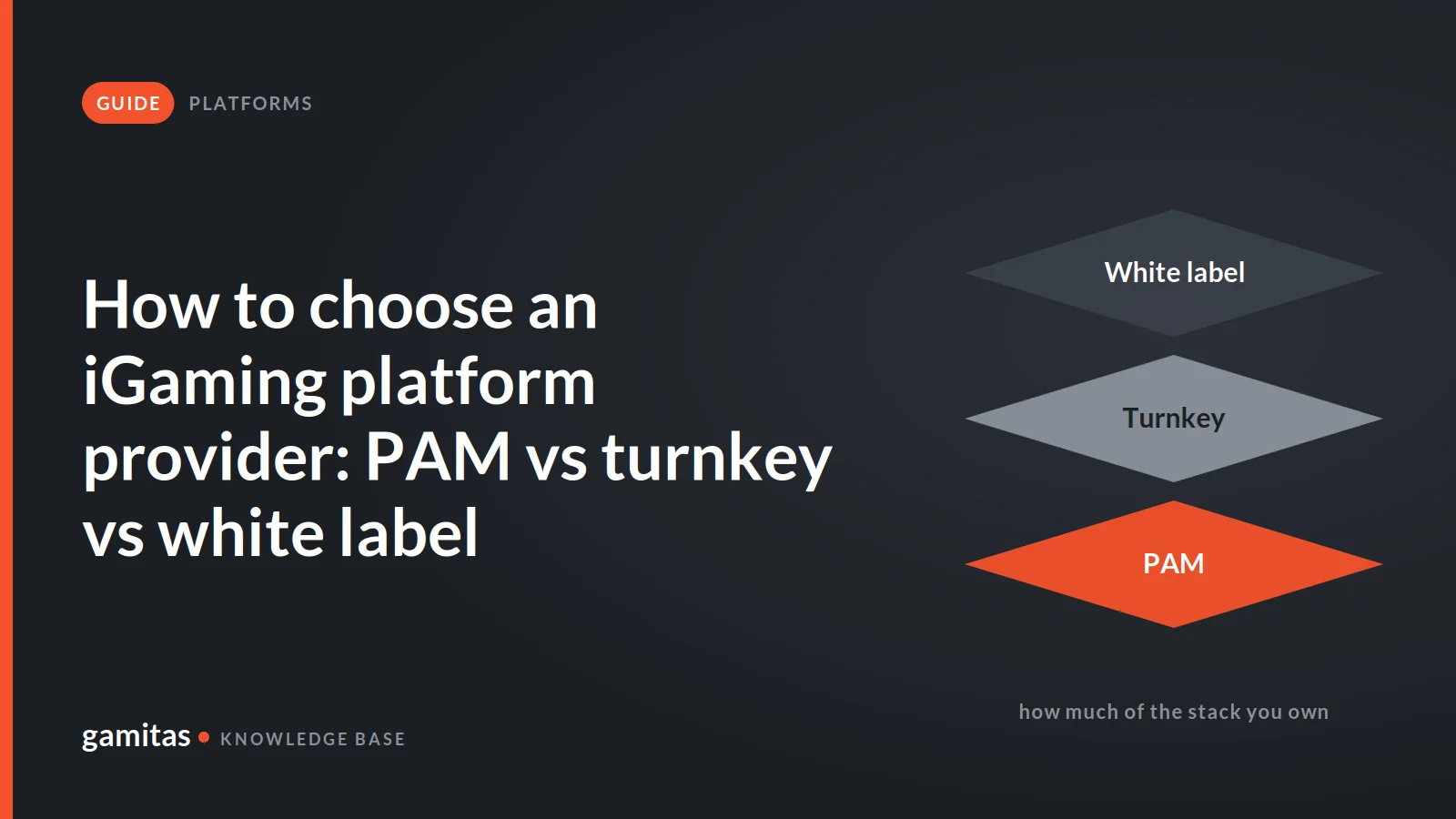
The Gamitas marketplace lists 49 white label and turnkey suppliers, including SOFTSWISS, EveryMatrix, BetConstruct and Slotegrator. Filter the list by regulator and live market to find providers whose licences match the markets you are aiming for, both now and next. Then shortlist three and put the questions above to each one. If you are still weighing white label against PAM and turnkey, our guide to choosing an iGaming platform provider compares all three. To see the wider market, browse all platform providers.
FAQs
What does white label casino mean?
It means running a casino under your own brand on a platform built and operated by another company. The provider supplies the technology, games and payments, and often the licence. You supply the brand and the players.
Is a white label casino legal?
Yes, when the site operates under a valid licence for every market it serves. In the UK, for example, the licensee remains legally responsible and your brand acts as its marketing partner. Always confirm whose licence covers your site and which markets it allows.
What is the difference between white label and turnkey?
With a white label, you usually operate under the provider's licence and pay a revenue share for the full package. With turnkey, you use a ready-built platform but hold your own licence. That gives you more control and lower variable costs as GGR grows, in exchange for more upfront work and cost.
How long does it take to launch a white label casino?
On a provider's licence, typically a few weeks. If you need your own licence, plan for several months, depending on the jurisdiction.
Can you move from a white label to your own platform later?
Yes, but it only goes smoothly if your contract lets you keep the player database, domain and brand. Settle those terms before you sign, not when you are ready to leave.
This guide is for general information and is not legal advice. Licensing rules and fees change, so confirm the current position with the relevant regulator or local counsel.
- UK Gambling Commission, FOI response on white label partnerships
- UK Gambling Commission, consumer notice on Stake leaving the GB market
- CMS, TGP fined for AML and social responsibility failures (April 2023)
- CMS, From Stake to TGP: advertising unlicensed gambling (May 2025)
- Curaçao Gaming Authority, notice on LOK provisional licences (23 June 2025)
- SOFTSWISS, White-Label Casino in 2026 (upfront cost estimates, updated 15 October 2026)
- Gamitas supplier profiles and licence records, October 2026