Every platform pitch sounds the same in the first meeting. The differences show up later, when you ask who holds the licence, who owns the player data and what it costs to leave.
Operators usually frame this as a technology decision. In practice it is a licensing and control decision first, and the technology follows from it. Pick the wrong model and no amount of good engineering on the provider's side will fix it, because the constraint sits with your regulator, not with your vendor.
This guide sets out what PAM, turnkey and white-label arrangements actually include, where each one fits, and the checks worth running before you sign. Where we have numbers, they come from the platform providers profiled on Gamitas as of October 2026.
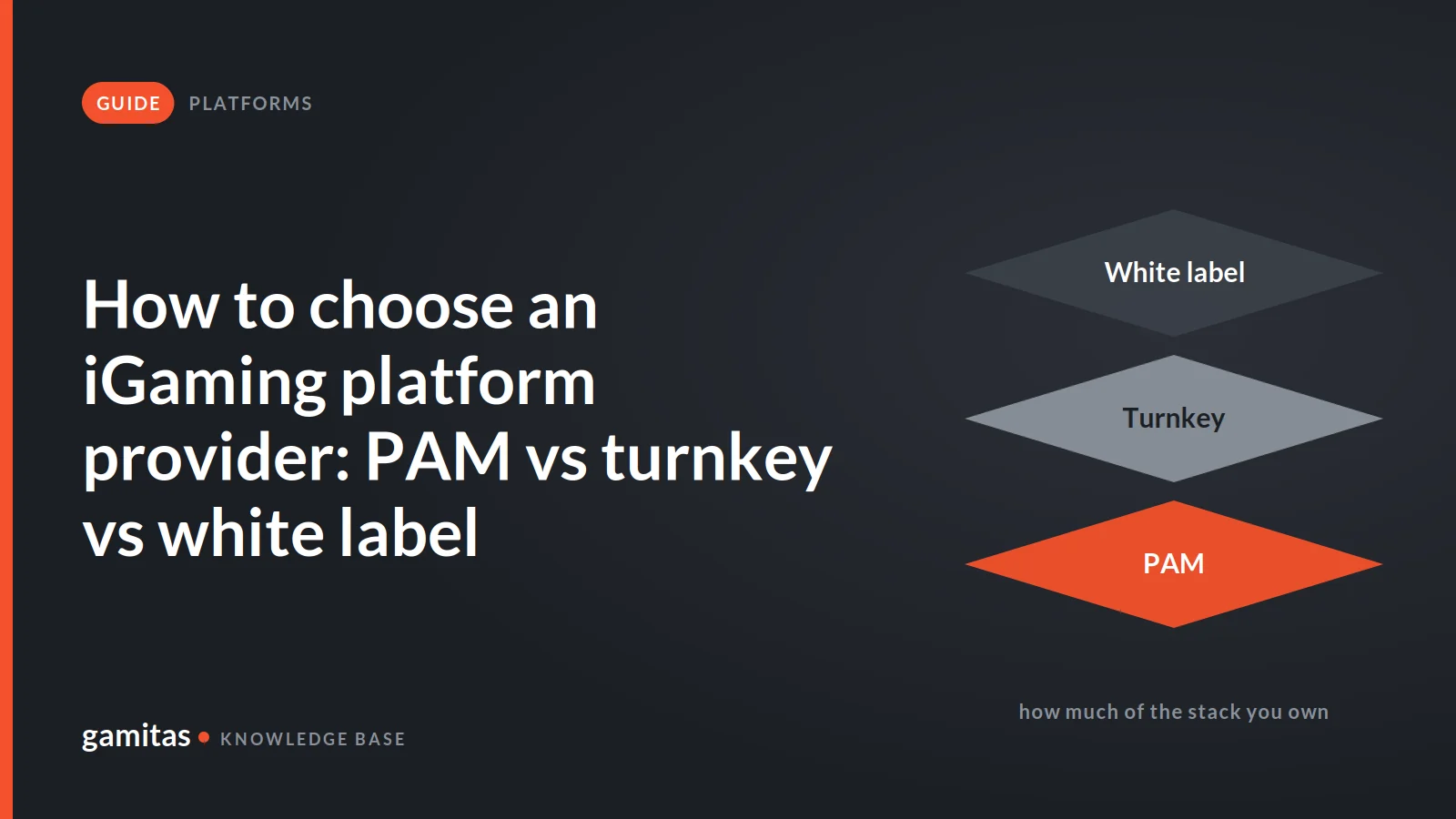
- White label is the fastest route to market, but you are usually trading on someone else's licence and their rules. Many regulated markets will not allow it at all.
- Turnkey gives you the whole stack under your own licence. It suits operators who want to own the brand and the customer without building the technology.
- A standalone PAM is the core you build around. It gives the most control and leaves you responsible for everything else.
- Three quarters of the providers we track sell more than one of these, so the label on the website tells you less than the contract will.
The three models in plain terms
The terms get used loosely, and some providers use all three on the same page. These are the working definitions most procurement teams settle on.
PAM (player account management)
The PAM is the system of record. It holds player accounts, the wallet, KYC status, limits and self-exclusion flags, bonus logic and the reporting your regulator will ask for. Everything else plugs into it: the casino content, the sportsbook, payments, CRM. Buying a PAM on its own means you choose and integrate those other pieces yourself, or pay someone to.
Turnkey
A turnkey deal is a PAM plus the pieces around it, already integrated: front end, casino content through an aggregator, often a sportsbook, payment methods, sometimes CRM and managed services. You run it under your own licence and your own brand. The provider supplies and operates the technology; the regulatory responsibility stays with you.
White label
In the classic white-label set-up the provider holds the gambling licence and you operate a branded site underneath it. You bring the brand and the marketing; they bring the licence, the platform, payments and often the customer support. It is quick and cheap to start. It is also the model with the least control and, in many jurisdictions, the least regulatory room.
| Standalone PAM | Turnkey | White label | |
|---|---|---|---|
| Whose licence | Yours | Yours | Usually the provider's |
| What you assemble | Content, sportsbook, payments, CRM, front end | Little: it arrives integrated | Almost nothing |
| Time to launch | Longest | Medium | Shortest |
| Control over product and data | Highest | High, within the provider's roadmap | Lowest |
| Typical commercials | Licence or SaaS fee, plus your own integration costs | Set-up fee plus a revenue share or monthly fee | Revenue share, often a large one |
| Cost of leaving | Lower: you own most of the stack | Medium: data migration and re-integration | Highest: the licence and often the players stay behind |
| Best fit | Established operators with an in-house tech team | New or expanding operators that want their own licence | Brand owners and affiliates testing a market |
The licence decides more than the technology
Before comparing feature lists, settle one question: does the market you want to enter let you operate under someone else's licence?
In most tightly regulated European and North American markets the answer is no, or only under strict conditions. The operator facing the player needs its own licence, and the platform provider needs its own supplier licence on top. That rules out the classic white label and leaves you choosing between turnkey and a PAM build. The white-label model survives mainly in jurisdictions where one licence can cover several brands, and that is exactly why it shows up so often in offshore set-ups.
Two different licences. A provider's B2B supplier licence lets them sell technology to licensed operators. It does not let you take bets. If a white-label offer leans heavily on the provider's "licence", ask which one it is and whose name is on it. Our guide to B2B and B2C gambling licences covers the difference in more detail.
What the provider market actually looks like
We profile 99 platform providers. Very few of them do only one thing. A quarter list a single platform service; the rest combine two or more, and 26 offer four or five. A company that calls itself a PAM provider will often sell you the full turnkey package as well, and a white-label specialist frequently runs on a PAM it licenses out separately.

The practical point: do not shortlist on the category label. Shortlist on the parts of the stack you need the provider to own, then ask each candidate which of those they built, which they license from someone else, and which they simply resell. The answers vary more than the websites suggest.
You can browse providers by service on Gamitas, for example PAM providers or white-label and turnkey providers, and filter by the licences they hold.
Five questions that usually settle it
- Will you hold your own licence in the target market? If yes, white label is mostly off the table. If you cannot or do not want to, it may be your only option, and you should price in the loss of control that comes with it.
- Do you have engineers who can own integrations? A standalone PAM pays off only if someone in-house can integrate and maintain content, payments and CRM. Without that team, turnkey is usually cheaper over three years even with a revenue share.
- How many markets in the next two years? Each new market can mean new certification, new reporting and new local payment methods. Ask how many of your target markets the provider already supports live, not on the roadmap.
- Who owns the player data on exit? Get the answer in the contract, including the export format and the timeline. This matters most for white label, where the players may legally belong to the licence holder.
- What is the real all-in cost? Add the set-up fee, the revenue share or monthly fee, aggregator and content fees, payment fees and the people you will need. A low headline revenue share with expensive add-ons is common.
Checks worth running before you sign
Sales decks rarely mention who the platform belongs to or which entity holds the supplier licence. Both are easy to check and both change the risk profile.
Find the licence on the register, under the right name. Of the 99 platform providers we profile, 49 have at least one gaming licence on record that we could tie to the entity they trade through, and 34 of those we confirmed directly on a regulator's own register. The rest either operate in markets that do not license suppliers, hold licences we could not match to a named entity, or publish no licence details at all. None of that is automatically disqualifying, but you should know which group your shortlist falls into.

Check who owns them. Consolidation is steady in this part of the market. Several platforms we looked at this year turned out to be brands of larger groups, which affects your negotiating position, the provider's roadmap and what happens if that group is sold again.
Ask for live references in your market. A logo wall is not a reference. Ask for two operators live on the same product in the same jurisdiction, and speak to them without the provider in the room.
Watch the exit terms. The cheapest platform to join is often the most expensive to leave. Check notice periods, data export obligations, who owns the domain and front-end code, and whether the revenue share continues on players you migrate. If you are leaning towards white label, run through our 12 red flags first.
For a structured way to compare candidates once you know which model you want, our guide on how to shortlist an iGaming supplier walks through the scoring.
The bottom line
Choose the licence model first, then the commercial model, then the technology. White label buys speed and gives up control. Turnkey keeps the brand and the licence with you and leaves the engineering to the provider. A standalone PAM gives you the most freedom and the most work. None is better in the abstract. The right one is the model whose trade-offs you can live with in the specific market you are entering.
- Malta Gaming Authority, licensee register
- UK Gambling Commission, public register
- Gamitas supplier profiles and licence records, October 2026