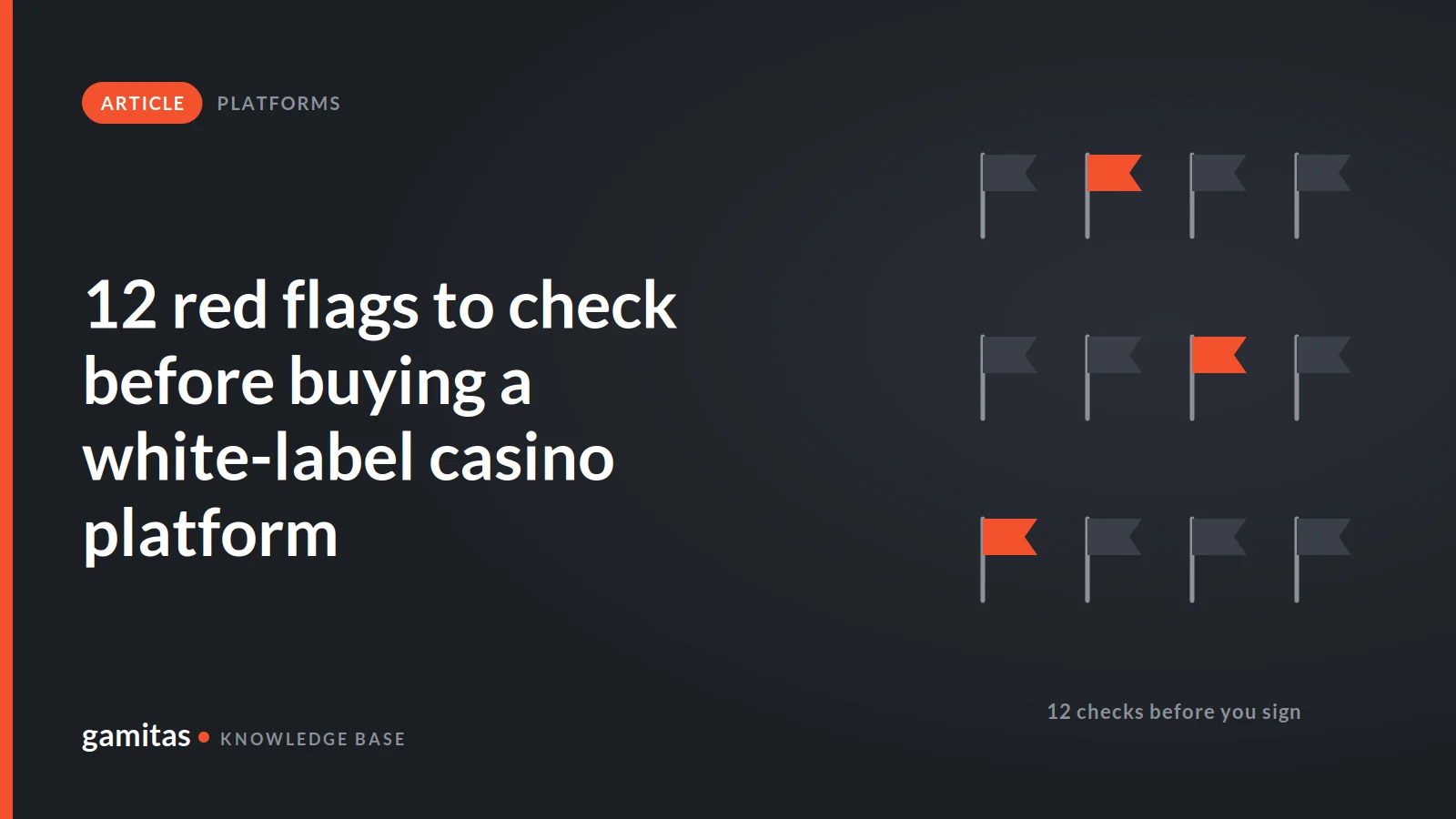
A white-label casino can be live in weeks. That speed is the selling point, and it is also why so many offers in this corner of the market do not survive a careful look.
This year we reviewed 169 companies presented as platform, turnkey or white-label providers for possible listing on Gamitas. 43 met our standard. The other 126 failed for reasons that repeat often enough to turn into a checklist, and that checklist is what follows.
None of these red flags proves a provider is dishonest. Some belong to small, genuine teams that simply have not published much. But each one is a question you should get a clear answer to before money or players move.

Red flags about the company
1. You cannot find the legal entity
This was the second most common failure in our review. The footer says "© 2026 BrandName", the privacy policy refers to "the Company", and the terms never say which company that is. If you cannot name the legal entity, you cannot check its licence, its registration or who stands behind the contract you are about to sign.
Ask for: the full registered name, the company number and the country of registration, then look them up yourself.
2. The licence claim does not check out
We regularly found licence logos with no number, numbers that did not appear on the regulator's register, and seals that opened a "not found" page. One footer carried a licence number that was literally a placeholder of X's. A real B2B licence has a holder, a number and a status you can see on the regulator's own site.
Ask for: the licence number and the link to the regulator's entry, not to the provider's own certificate page. Our guide on how to verify a gaming licence shows where to look for each regulator.
3. The licence is held by someone else
Some offers lean on "our licence" when the licence belongs to a sister company, a former parent or an unrelated firm the provider sub-licenses from. Sometimes that is a legitimate group structure. Sometimes it is a resale arrangement the licence holder may not know about.
Ask for: a written explanation of how the licence holder relates to the company you are contracting with.
4. The provider offers to "get you a licence"
Licensing support is a real service, usually sold by law firms and consultancies. When the platform vendor itself bundles a licence into the package, especially from a jurisdiction with light supervision, the licence is often doing the selling. Ask who will hold it, who will be the responsible persons and who answers the regulator.
5. It belongs to a group you were not told about
Twenty of the candidates we reviewed turned out to be brands or subsidiaries of groups already in our directory. That is not a red flag in itself, but it matters if nobody mentioned it. It changes who you are really negotiating with and what happens if the group sells the business.
Red flags about the product
6. One page, no products
A single landing page with "2,000+ games, 100+ providers, sportsbook, crypto, fast launch" and a contact form is the most common shape of a reseller. There are no product pages, no documentation and no screenshots of the back office. Genuine platform owners usually publish more because they have more to show.
7. The content list is borrowed
Many small aggregators are re-selling access to a larger aggregator's API. That is allowed when the contract permits it, but it adds a layer of fees and a layer of risk. If the big aggregator cuts them off, your games go dark.
Ask for: which studios are integrated directly and which come through a third party, and whether those studios have approved the arrangement.
8. No named clients or partners
Twenty-one candidates in our review named no operator, studio or payment partner anywhere we could find. "Trusted by 200+ brands" with unlabelled logos is not a reference. Ask for two live clients you can call.
9. Nothing has happened since 2023
The most frequent failure, by a wide margin, was a lack of any dated activity in the past two years: no announcements, no launches, no conference appearances, a news page frozen on an old post. A platform is a long-term dependency. You want evidence the company is still shipping.
Red flags in the commercial terms
10. Payment and sales only through messaging apps
Sales handled entirely over Telegram or WhatsApp, prices quoted in crypto only and no invoice from a registered company are a pattern we saw repeatedly among the grey-market candidates. Fine for a first conversation; not fine for a contract.
11. The exit clause is missing or one-sided
Under a white-label deal the players may legally belong to the licence holder. Check what you get on exit: player data, the domain, the front-end code, the marketing database. If the contract is silent, assume the answer is nothing.
12. The markets do not match the licences
A provider promising launches in regulated European markets while holding only an offshore supplier licence cannot deliver what it is selling. Map every target market against the licences the provider actually holds today.
A closer look: Curaçao's B2B licensees
Curaçao is where many white-label and turnkey providers are licensed, so we went through the regulator's own register. The Curaçao Gaming Authority's licence registry, dated 2 June 2026, lists 657 licences issued under the new framework. Only 87 of them are B2B supplier licences. We looked at every one.

A Curaçao B2B licence is real and checkable, and each licence has a certificate page on the regulator's portal. But the licence on its own told us very little about the business behind it. For 26 licensees we could not find any brand or website at all. Another 21 had a site, but nothing on it you could evaluate. A licence is where due diligence starts, not where it ends.
More on the jurisdiction, including how the licensing framework works, is on our Curaçao compliance page.
How to use this list
Treat it as a set of questions, not a scoring sheet. A provider that clears all twelve is not automatically a good partner, and one that trips two may have a perfectly good explanation. What matters is whether you get straight answers.
If you want a fuller process, our supplier due diligence checklist covers the documents to request and the order to request them in. You can also browse white-label and turnkey providers on Gamitas; every licence marked as verified links to the regulator's own entry.
- Curaçao Gaming Authority, Online Gaming License Registry (2 June 2026)
- Curaçao Gaming Authority, licence certificate portal
- Gamitas review records, 2026