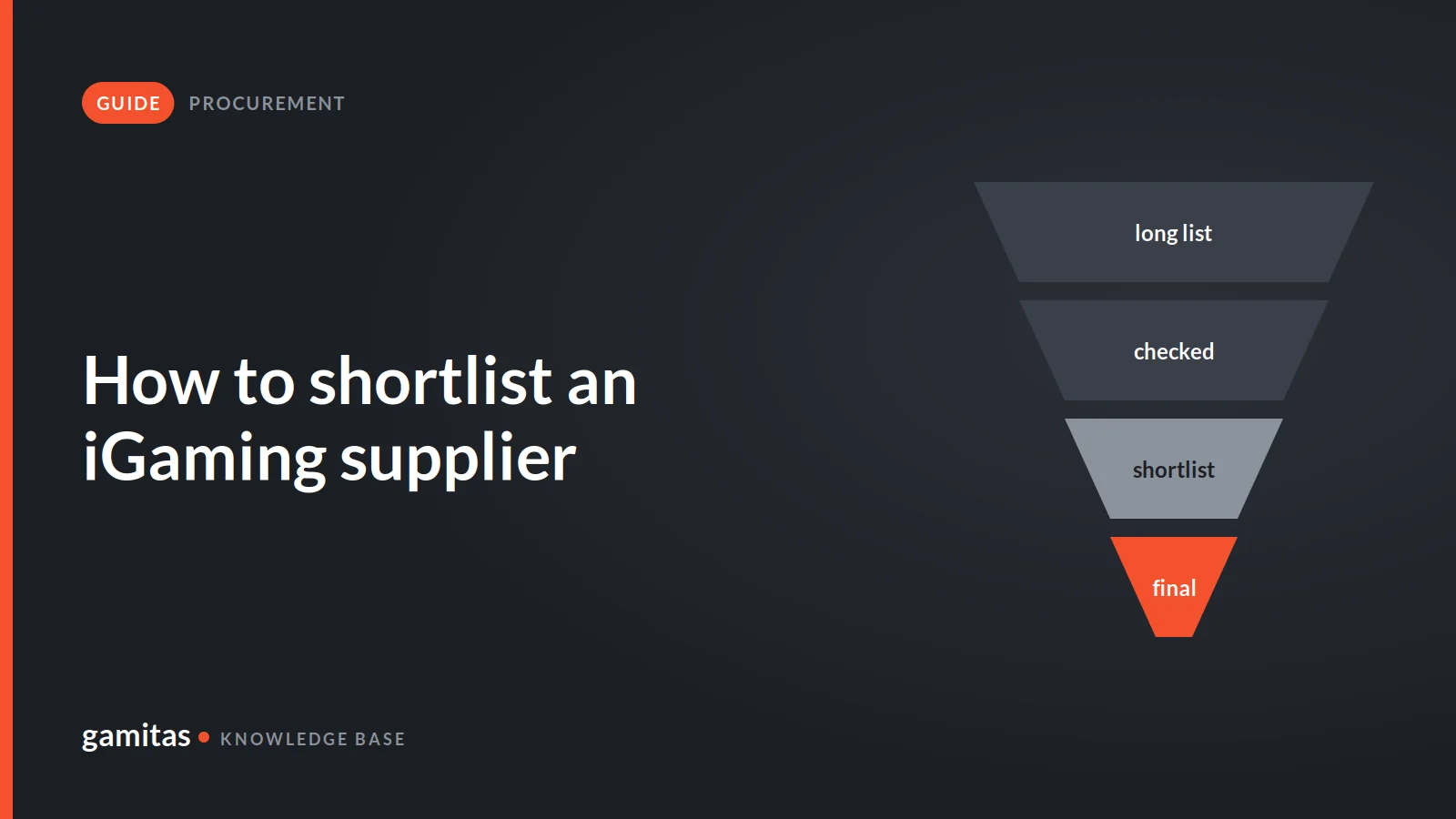
Most supplier selection goes wrong in the same way: a long list, a round of demos, and a decision made on the demo rather than on whether the supplier can legally and practically serve you. This is the order that avoids that.
- Eliminate on legal and technical fit before you look at any product.
- Most of the elimination can be done from a desk, without contacting anyone.
- Demos come last, and only for suppliers that already passed.
Why the order matters
A demo is persuasive and cheap to give. If you watch demos first you will form preferences, and you will then look for reasons that your preferred supplier can work rather than reasons it cannot. Running the elimination first means the demos you watch are all from suppliers you could actually sign.
1. Can they supply your market at all?
Not “are they licensed”, but licensed where you operate, under the right activity. Ask for the legal entity name and the licence number, then check it yourself where the regulator publishes a register.
This is the fastest cut. In most longlists it removes a third.
2. Is the licence the right class?
Licences carry activity types. A gambling software licence is not a game host licence; a platform provider registration is not a critical systems registration. A supplier may hold one and need both for what you are buying.
Ask which activities their licence covers in your market, and compare that to what you actually need them to do.
3. Which of their products are certified here?
Certification usually runs product by product, not portfolio-wide. A studio with 300 titles may have 40 certified in your market. A platform certified for casino may not be certified for sportsbook.
Ask for the certified list for your market in writing. The global catalogue is not what you are buying.
4. Who else are they live with here?
Named operators in your market are the most checkable claim a supplier can make — you can open a competitor's lobby and look. It also tells you whether the integration has been run in your regulatory environment or only in theory.
If they cannot name anyone locally, you are their first, and first integrations take longer than anyone estimates.
5. Direct or through an aggregator?
This decides who you contract with, who you escalate to at 2am, and what your margin looks like. A studio reached through an aggregator means the aggregator owns the relationship and takes a cut, and your available titles are the ones the aggregator has certified.
Neither route is wrong. Not knowing which one you are on is.
6. What does integration actually require?
Ask for the integration document before you sign, not after. The questions that matter: is it one API or one per product; who hosts what; what does certification of the integration itself require in your market; and what is the realistic elapsed time, including the regulator's part.
Suppliers quote development time. The regulator's queue is usually longer than the build.
7. What happens when something breaks?
Support hours in your timezone, escalation path, incident history. A supplier whose support runs European business hours is a poor fit for a Latin American operation with a Sunday-night peak.
Ask for their last significant incident and what they changed afterwards. The answer, or the refusal, is informative either way.
8. Only now, the product
By this point the list is short and everything on it can legally and practically serve you. Watch the demos. Ask for performance data from operators comparable to you — same market, similar player base — because a title that performs in Sweden tells you little about Peru.
A realistic timebox
Steps one to three: an afternoon for a longlist of twenty, if the regulators involved publish registers. Steps four to seven: one email per supplier and a week of waiting. Step eight: as long as you like, on a list of three or four.
The mistake worth avoiding is spending that week on all twenty. Nothing in steps four to seven is worth asking of a supplier that fails step one.