If you want 3,000 games live by next quarter, an aggregator is the only realistic way to get there. If you want a game from one studio live on day one with exclusive mechanics, it usually is not.
Most operators end up using both. The real question is which content goes through which route, and that depends on volume, cost, control and the markets you operate in. This guide sets out how each route works, what it costs you in practice, and a simple way to split your catalogue between them.
How the two routes work
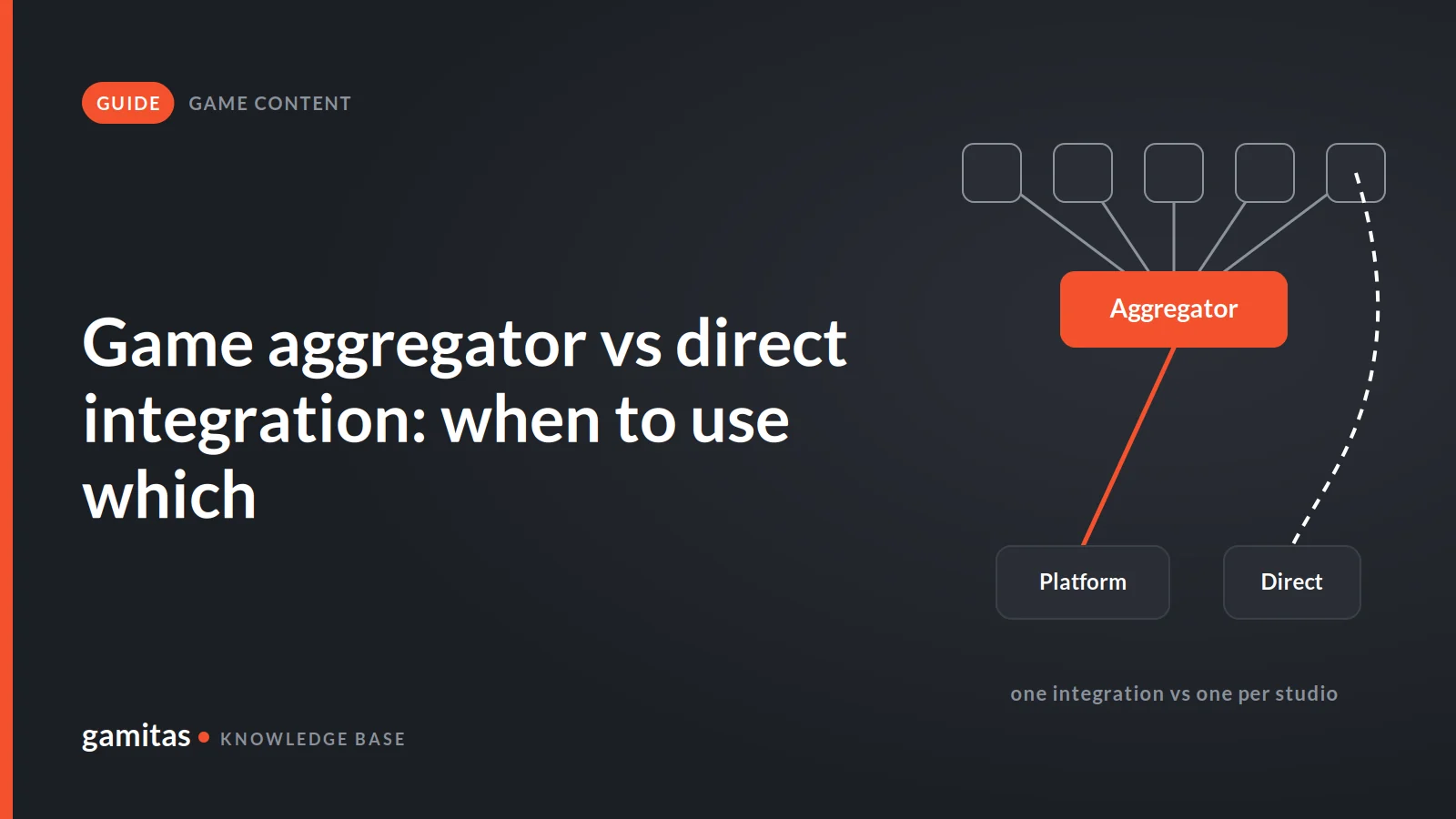
Direct integration means your platform connects to a studio's remote game server through the studio's own API. You sign with the studio, integrate once per studio, and handle certification, reporting and promotions with each one.
Aggregation puts a layer in the middle. The aggregator has already integrated hundreds of studios; you integrate the aggregator once and switch studios on from a back office. One contract, one wallet integration, one invoice. In exchange, the aggregator takes a cut and becomes a dependency you need to manage.
Many large platforms now run their own aggregation layer, and many aggregators sell a PAM or turnkey package as well, so the line between the two is blurring. What matters is how many hops sit between your wallet and the studio's game server.
What the integration records show
We record the integration partners each supplier names publicly: operators, platforms, aggregators, payment providers. Across the 175 game providers on Gamitas we hold 218 integration records. Almost half are aggregator partnerships. Direct platform integrations account for a little over a fifth.

Studios, in other words, lean on aggregators more than on any other route. A handful of names come up repeatedly as the aggregator partner a studio chose to announce:

You can browse all game aggregation providers on Gamitas, or start from the game provider directory and check which aggregators each studio already works with.
Side by side
| Through an aggregator | Direct integration | |
|---|---|---|
| Speed to large catalogue | Fast: hundreds of studios from one integration | Slow: one studio at a time |
| Cost per game round | Higher: the aggregator's share sits on top of the studio's fee | Lower: you pay the studio only |
| Engineering effort | One integration to build and maintain | One per studio, each with its own quirks |
| Control over promotions and tools | Limited to what the aggregator exposes | Full access to the studio's own tools |
| Early access and exclusives | Rare | Common for larger operators |
| Commercial relationship with the studio | Indirect | Direct, which helps in negotiations |
| Concentration risk | High: if the aggregator goes down, so do its games | Spread across studios |
| Regulated market coverage | Depends on the aggregator's own licences and each studio's certifications | Depends on each studio's licences and certifications |
The cost question
Aggregators are typically paid as a share of gross gaming revenue on the content they carry, layered on top of what the studio charges. On a long tail of games each earning a little, that extra share is a fair price for not having to build and maintain dozens of integrations. On the handful of titles that make most of your revenue, it can add up to more than the cost of integrating those studios yourself.
That is the logic behind the split most operators arrive at: go direct with the few studios that drive the bulk of your casino revenue, and aggregate the rest.
Run the numbers on your top ten studios. Take their share of your casino GGR, multiply by the aggregator's fee, and compare that annual figure with the one-off cost of a direct integration plus maintenance. For most operators the answer changes once a studio passes a certain share of revenue, and that is your cut-off.
In regulated markets, licences decide the route
In markets that license suppliers, both the studio and the aggregator usually need their own approval, and games are often certified per market. A studio can be licensed in a market where its aggregator is not, or the other way round, and either gap can keep a game off your site.
So before you choose a route for a given studio, check three things: is the studio licensed or registered in your market, is the aggregator, and are the specific games certified there. On Gamitas, licences marked as verified link to the regulator's own entry, so you can confirm each one at source, and our licence verification guide covers the main registers.
A simple way to split your catalogue
- Rank studios by expected revenue. Use your own data if you have it, or the market leaders in your jurisdiction if you are launching.
- Go direct with the top tier. Usually five to ten studios. You gain lower costs, earlier releases and access to their promotional tools.
- Aggregate the long tail. Everything else comes through one or two aggregators, which keeps your catalogue wide without the engineering burden.
- Use two aggregators, not one, if you can. It reduces concentration risk and gives you bargaining power on price.
- Review once a year. When a studio moves into your top tier, move it to a direct integration.
Questions to ask an aggregator
- Which studios do you integrate directly, and which come through another aggregator?
- Which of your licences cover my target markets, and can I see them on the regulator's register?
- Which games are certified in my markets today, as opposed to available in general?
- What happens to my games and my data if you lose a studio contract, or the studio loses its licence?
- Which promotional tools (free rounds, tournaments, jackpots) pass through to me, and at what extra cost?
Aggregators of aggregators. Some smaller "aggregators" resell another aggregator's feed. You end up paying two layers of fees and depending on a contract you cannot see. Ask the question directly and get the answer in writing.
The bottom line
Aggregation buys breadth and speed. Direct integration buys margin and control. Studios lean on aggregators more than on any other route to reach operators, so you will almost certainly use one. Just do not put the studios that pay your bills behind a layer you do not control.
- Gamitas integration records, October 2026