"Affiliate" covers at least three different businesses in iGaming, and mixing them up is how operators end up paying a network to do what their own programme should, or hiring an agency to fix a tracking problem.
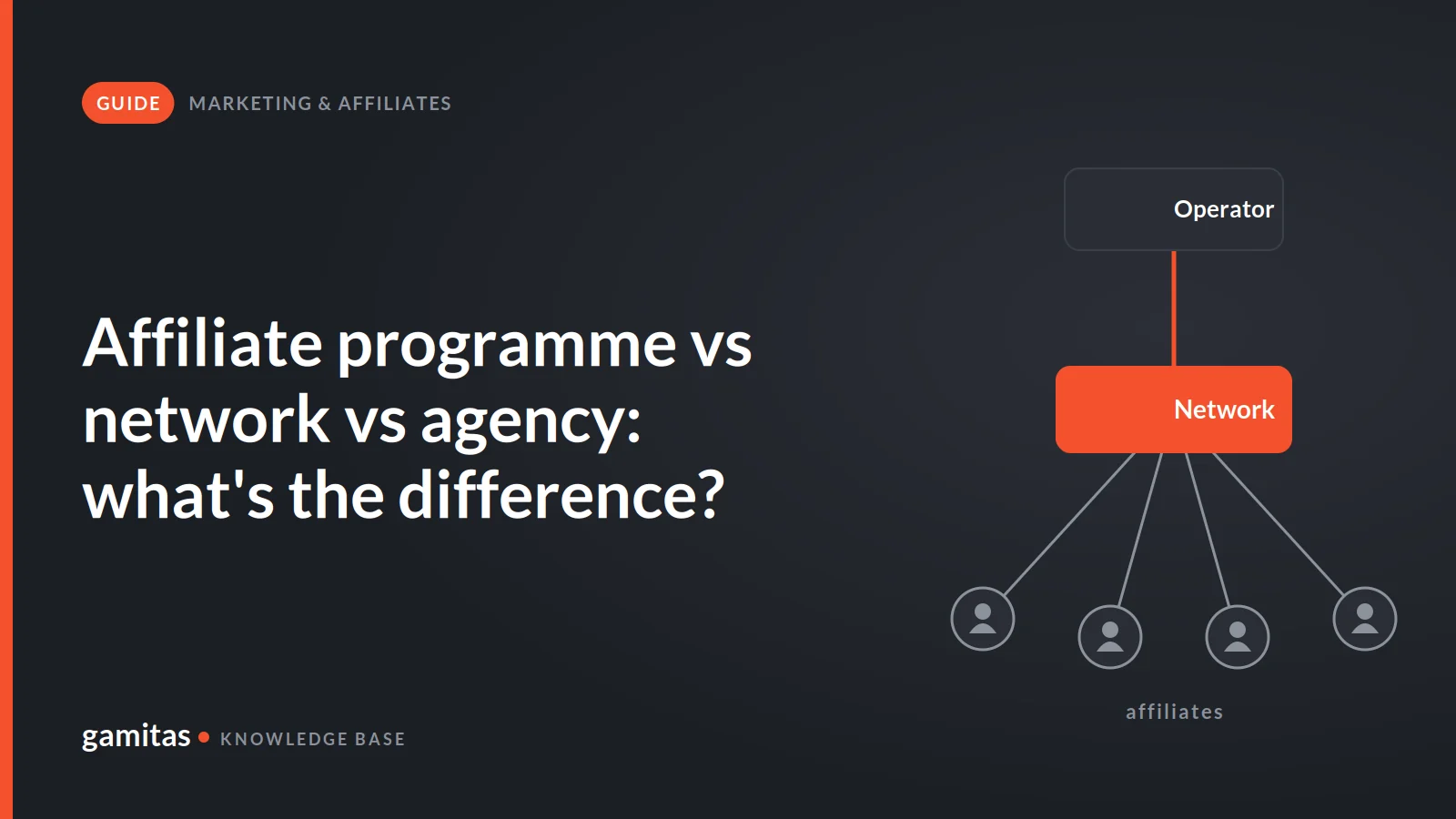
An affiliate programme belongs to an operator. An affiliate network sits between many operators and many affiliates. An affiliate agency sells services: it acquires traffic, runs campaigns or manages your programme for a fee. Each is paid differently, carries different risks and answers a different question. This guide separates them.
- Programme: run by the operator, for the operator's own brands. You set the deals and own the relationships.
- Network: an intermediary with many operator offers and many affiliates. Fast reach, less control, a margin in the middle.
- Agency: a service provider you pay to generate traffic or to run your programme. Judge it on results and transparency, not reach.
- Affiliate software is the tracking platform underneath all three. It is a supplier, not a channel.
The three models
Affiliate programme
An operator's own programme recruits affiliates such as comparison sites, tipsters and streamers, and pays them for the players they send. The operator sets the commission plans, approves the affiliates, owns the tracking data and is responsible for what affiliates say about its brands. Large operators often run one programme across several brands.
Because a programme serves one operator, we do not list it as a supplier on Gamitas. During our reviews this year we set aside around 70 candidates that turned out to be an operator's in-house affiliate programme rather than an independent B2B business.
Affiliate network
A network aggregates offers from many operators and makes them available to many affiliates. The affiliate gets one account, one payment and a choice of brands; the operator gets access to traffic it would not have recruited itself. The network takes a margin between what the operator pays and what the affiliate receives.
In iGaming the word is also used for large publisher groups that own many comparison and review sites. They are affiliates at scale rather than intermediaries, but they often describe themselves as networks.
Affiliate agency
An agency is paid to deliver something: traffic through media buying, content and SEO for a programme, influencer campaigns, or the day-to-day management of an operator's programme. Some agencies take a fee, some take a share of revenue, many mix the two.
| Affiliate programme | Affiliate network | Affiliate agency | |
|---|---|---|---|
| Who runs it | The operator | An independent intermediary | A service company hired by the operator |
| Who the affiliates deal with | The operator directly | The network | The agency, or nobody if it generates traffic itself |
| How it is paid | Operator pays affiliates CPA, revenue share or hybrid | Margin between operator payout and affiliate payout | Retainer, fee per result or revenue share |
| Control over who promotes you | Full | Partial: depends on network vetting | Depends on contract and transparency |
| Speed to traffic | Slow to build | Fast | Fast, if the agency owns traffic sources |
| Main risk | Cost and effort of recruiting and managing affiliates | Low-quality or non-compliant traffic you did not approve | Paying for activity rather than outcomes |
| Best fit | Established operators building a long-term channel | New brands and markets that need reach quickly | Operators short on in-house marketing capacity |
How the money works
Three commission structures cover most deals. A CPA pays a fixed amount per qualifying player, usually after a minimum deposit. A revenue share pays a percentage of the net gaming revenue the player generates for as long as they play. A hybrid combines a smaller CPA with a smaller revenue share.
The structure matters most in a network. Every layer takes a margin, so the same player can cost an operator noticeably more through a network than through its own programme. That can still be worth paying for reach. Just compare like with like: the network's effective cost per depositing player against what your direct affiliates cost.
Regulated markets add obligations. In many licensed markets the operator is responsible for what its affiliates publish, whichever channel they arrived through. A network or agency does not take that responsibility away. Ask how each partner vets affiliates and what happens when one breaks the rules.
Where affiliate software fits
All three models run on tracking software: the system that attributes players to affiliates, calculates commission and produces the reports. Operators license it for their own programme, networks run it at scale, agencies use it to report results. On Gamitas, 15 companies list affiliate software as a service, and 16 list affiliate networks.

When you assess software, the questions are practical: does it handle your commission plans, your currencies and your markets, does it integrate with your platform's player data, and can affiliates see their own numbers without asking you. You can compare providers in our affiliate software category.
Choosing between them
- Start with your own programme if you can. It is the cheapest long-term source of affiliate traffic and the only one where you own every relationship.
- Add a network for reach. When you launch a new brand or market and need traffic quickly, a network can fill the gap while your programme grows. Browse affiliate networks on Gamitas.
- Hire an agency for capacity, not for strategy you do not have. An agency can run campaigns or manage a programme well. It cannot decide for you which markets and players you want.
- Track every channel in one place. Whatever mix you choose, measure cost per depositing player and player value by channel, so you can move budget to what works.
Checks before you sign with a network or agency
- Is it independent, or is it really an operator's own programme recruiting for its brands?
- Which legal entity will you contract with, and where is it registered?
- How are affiliates and traffic sources vetted, and can you block specific ones?
- Will you see which affiliates sent which players, or only the totals?
- What are the payment terms, the clawback rules for fraud and the notice period?
- Can it show you two operators it works with in your market?
For a general framework that applies to any supplier, our guide on how to shortlist an iGaming supplier sets out the scoring we use.
The bottom line
A programme is yours, a network is borrowed reach, and an agency is rented capacity. Most operators end up with all three. The mistake is not using the wrong one, it is paying for one while believing you have bought another.
- Gamitas supplier profiles and review records, October 2026