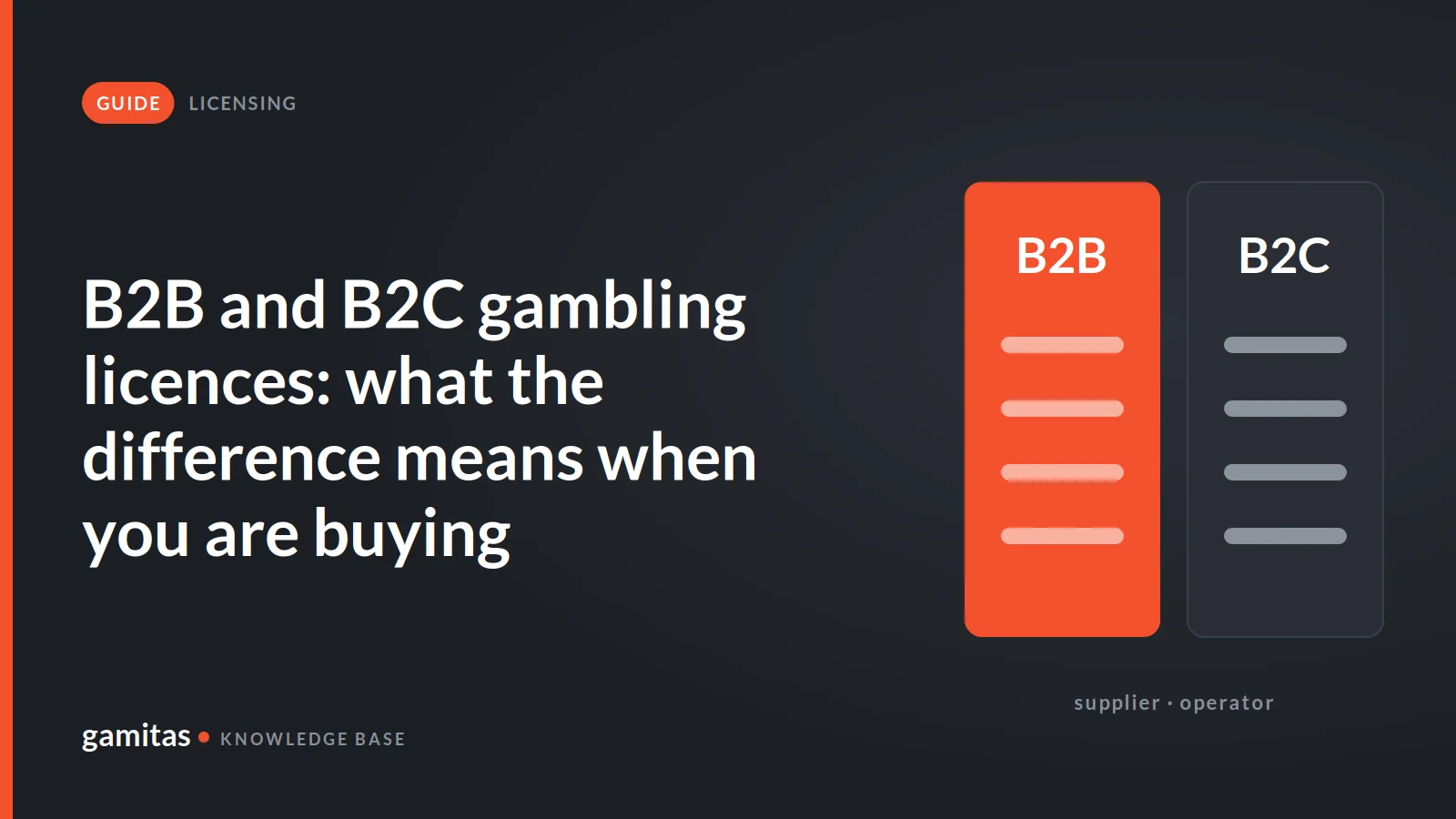
A B2C licence lets you take bets from the public. A B2B licence lets you supply the people who do. They are not tiers of the same thing, and a supplier holding one cannot do the other's job.
- B2C is permission to face players. B2B is permission to supply operators.
- Holding B2B does not let a supplier take a single bet.
- Several markets did not require B2B licences at all until recently.
- Turnkey arrangements are where the distinction most often goes wrong.
What a B2C licence covers
The operator licence. It permits offering gambling to the public: accepting stakes, holding player funds, paying winnings. It carries the obligations that follow from facing consumers — age and identity verification, anti-money-laundering controls, responsible gambling tooling, advertising rules, dispute handling.
When a regulator penalises somebody for player harm, it is almost always a B2C licensee, because that is who holds the relationship with the player.
What a B2B licence covers
Supplying operators. Games, platforms, payment processing, aggregation, jackpot systems, data. The obligations are different in kind: technical standards, system integrity, random number generation, reporting to the regulator's systems, and in most regimes an obligation to supply only licensed operators.
That last point is worth pausing on. A B2B licence usually carries a duty to check your licence before supplying you. A supplier asking for your licence details is not being difficult; it is discharging its own obligation.
Why B2B licensing is newer than you think
Many mature markets licensed operators for years before they licensed suppliers. Denmark's original regime dated to 2012 and required supplier licences only from 2025. Sweden opened in 2019 and added B2B licensing later. The logic was that the operator was responsible for what it offered, so the supplier behind it needed no direct relationship with the regulator.
That has changed almost everywhere, for two reasons: regulators wanted visibility into the technology deciding outcomes, and because a single supplier failure affects every operator using it.
The practical consequence is that a supplier's position in a market may be newer than its presence there, and a licence granted in 2025 does not mean the supplier arrived in 2025.
Three places the distinction goes wrong
Turnkey deals
A turnkey provider supplies the platform, the games, the payments and often the operational running of a brand. It looks like the provider is the operator. Legally it is usually not — somebody has to hold the B2C licence, and the regulator holds that party responsible for everything the brand does.
Establish at the first meeting who will hold the operator licence. If the answer is you, you carry the regulatory risk for a product you did not build. If the answer is the provider, you are a marketing partner and should read the contract with that in mind.
White label
Similar, and worse when it goes wrong. Under most white-label arrangements the licence holder is the platform, and your brand operates under it. Regulators have increasingly held the licence holder responsible for what its white labels do — which means your conduct can cost somebody else their licence, and their other customers' failures can cost you your brand.
Aggregators
An aggregator holds a B2B licence and carries other studios' games. Whether those studios each need their own licence in your market varies by jurisdiction. Some require it; some treat the aggregator as responsible.
Get this answer in writing for your market before launch, because it determines how much of the catalogue you can actually switch on.
How to check which a supplier holds
Registers name the activity, not just the company. A UK entry distinguishes gambling software from game host; a Maltese one distinguishes critical from material supply, and gives a type number. Read the activity line, not the company name.
The one-line test
Ask: who is legally facing the player? That party needs B2C. Everyone behind them needs B2B in the markets where it is required. If nobody in the arrangement can answer that question quickly, that is the finding.