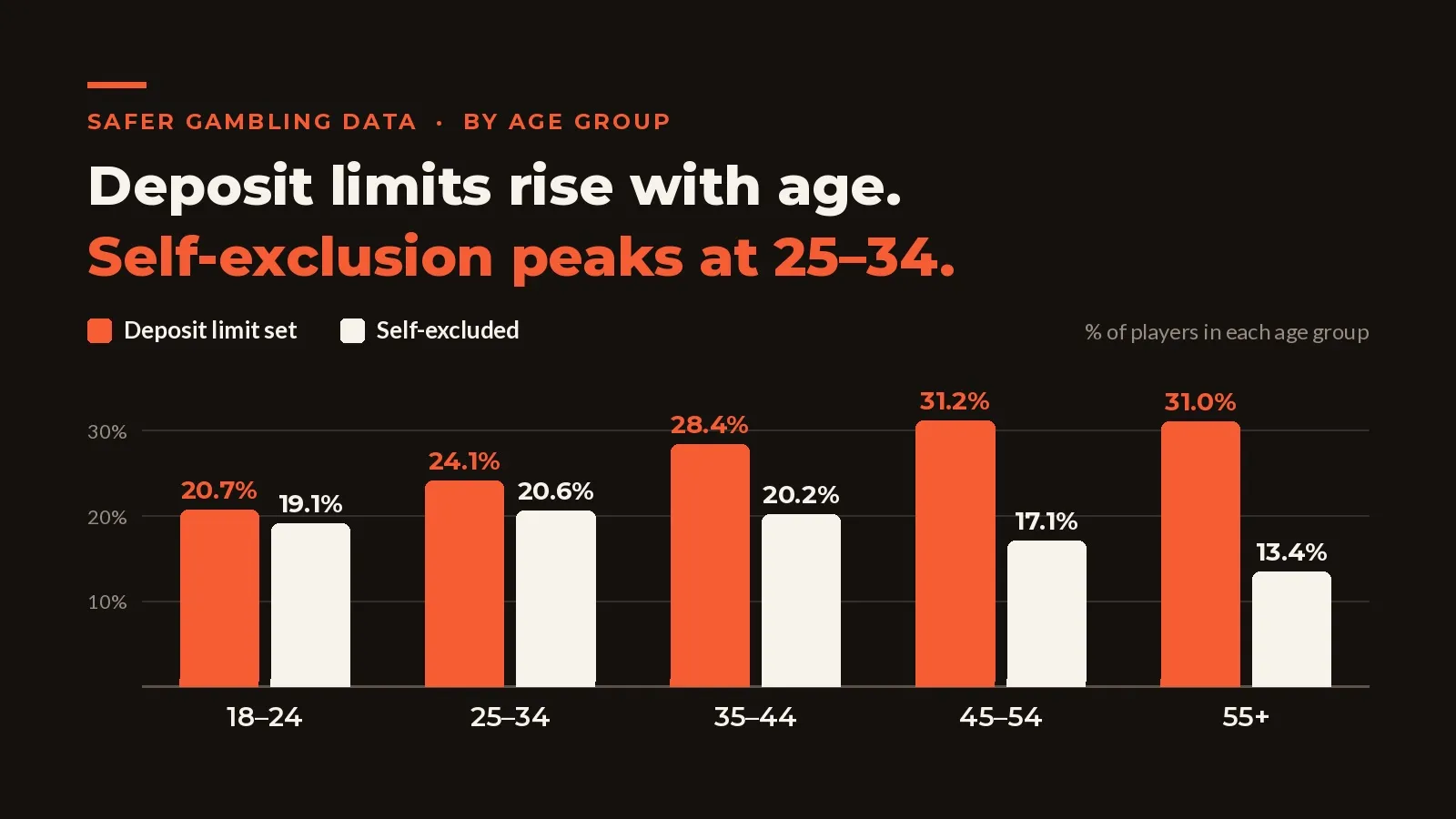
Younger players are the least likely to set a deposit limit, but they self-exclude almost as often as anyone. That is the headline from new anonymised data published by Genting Casino Online, which compares how five age groups use two of the most common responsible gambling tools.
- Deposit limit use rises from 20.7% of players aged 18–24 to a peak of 31.2% at 45–54.
- Self-exclusion follows a different curve, peaking at 20.6% among 25–34s and falling to 13.4% for players aged 55 and over.
- Among 18–24s the two tools are used at almost the same rate. Among players aged 55 and over, deposit limits are more than twice as common.
- The data shows how tools are used, not why, and says nothing about risk levels between age groups.
The figures were released alongside the launch of Genting Casino Online's new Safer Play Hub, which brings its responsible gambling tools, guidance and support resources into one place.
The numbers by age group
| Age group | Deposit limit set | Self-excluded |
|---|---|---|
| 18–24 | 20.7% | 19.1% |
| 25–34 | 24.1% | 20.6% |
| 35–44 | 28.4% | 20.2% |
| 45–54 | 31.2% | 17.1% |
| 55+ | 31.0% | 13.4% |
Deposit limits climb with age
Deposit limit use rises steadily through the age groups. One in five players aged 18–24 had set a limit, compared with 24.1% of 25–34s and 28.4% of 35–44s. Use peaks at 31.2% among players aged 45–54 and stays broadly level at 31.0% for those aged 55 and over.
That leaves a gap of 10.5 percentage points between the youngest group and the peak.
Self-exclusion moves the other way
Self-exclusion does not follow the same curve. It peaks at 20.6% among players aged 25–34, with 35–44s close behind at 20.2%. The figure is 19.1% for 18–24s, then falls to 17.1% for 45–54s and 13.4% for players aged 55 and over.
Put the two tools side by side and the contrast is clear. Younger players use a preventive tool and a stopping tool at almost the same rate. Older players lean heavily towards limits set in advance.
The Safer Play Hub
The new hub covers deposit limits, reality checks, cooling-off periods and self-exclusion, with guidance and research alongside the tools themselves.
“Our data highlights some interesting differences in how players across age groups use Responsible Gambling tools. Deposit Limit usage generally increases with age, while Self-Exclusion follows a different pattern, peaking among players aged 25–34. While the figures don't explain why players choose particular tools, they reinforce the importance of understanding how these options are being used and ensuring players have access to a range of support measures.
“Our new Safer Play Hub brings together Responsible Gambling tools, practical guidance and support resources in one place, making it easier for players to find information and understand the options available to them. As operators, we have a responsibility to make these resources accessible, communicate clearly and support informed decision-making. Safer Play is an ongoing commitment, and we want to ensure players can easily find the tools and guidance they need to make informed choices about their gambling.”
What the data does not tell you
Genting Casino Online is clear that the figures describe usage, not motivation or risk. A higher self-exclusion rate in one age group does not mean that group is more at risk, and a lower deposit limit rate does not mean younger players are less careful.
The release also leaves out details that matter when comparing this data with other operators:
- The time period. It does not say whether the figures cover a month, a year or the life of each account.
- The base. It does not give the number of players in each age group.
- The definitions. It does not say whether a deposit limit counts if it was later removed, or how self-exclusions are counted against active players.
Without those, the numbers are best read as one operator's pattern rather than a benchmark for the market.
Gamitas view
The deposit limit gap is the figure worth watching. Since 31 October 2025, the UK Gambling Commission has required online operators to prompt customers to set a financial limit before their first deposit, and from 30 June 2026 only a limit on money paid in can be called a deposit limit. Even with that prompt, only one in five 18–24s in this data has a limit in place. For operators and the suppliers who build their account and payment journeys, how the prompt is designed may matter as much as whether it appears. Suppliers working on player protection tools are listed in our compliance and risk category, and UK suppliers on the United Kingdom market page.